before the first sally
The Gentleman and His Books
A poor gentleman of [La Mancha](entity:location-recall-location-la-mancha-05c12a1ed921) spends his leisure reading books of chivalry until he neglects sleep, property, and ordinary judgment. Their impossible adventures become more real to him than the world around him.
He decides to become a knight-errant, restores old armor, names his gaunt horse [Rocinante](entity:character-recall-character-e14bcc940c7b), calls himself [Don Quixote of La Mancha](entity:character-recall-character-don-quixote-of-la-m-2d38ea17fdbf), and imagines the farm girl Aldonza Lorenzo as [Dulcinea del Toboso](entity:character-recall-character-dulcinea-del-toboso-3ec82aa5fe23).
early in the story
The First Sally
[Don Quixote](entity:character-recall-character-don-quixote-5e35e2b8dd96) rides out alone before dawn, believing the roads are waiting for his deeds. At an inn he imagines a castle, its serving girls as noble ladies, and the innkeeper as a castellan.
The innkeeper plays along and ceremonially dubs him a knight. Don Quixote leaves convinced that his career has properly begun, though he has neither money nor the equipment his imagined calling requires.
the morning after his dubbing
Andrés at the Oak
On the road home, [Don Quixote](entity:character-recall-character-don-quixote-5e35e2b8dd96) finds Andrés tied to an oak and being whipped by his master. He forces the farmer to promise payment of the boy’s wages and rides away believing he has redressed an injustice.
After Don Quixote has gone, the farmer ties Andrés up again and beats him worse than before. The failure of the intervention becomes an early demonstration that chivalric commands cannot guarantee justice in the real world.
later that same day
The Toledo Merchants
[Don Quixote](entity:character-recall-character-don-quixote-5e35e2b8dd96) blocks a group of [Toledo](entity:location-recall-location-00bd30d0cd7b) merchants and demands that they confess Dulcinea’s unsurpassed beauty without seeing her. When one asks for a portrait, Don Quixote charges at him.
[Rocinante](entity:character-recall-character-e14bcc940c7b) stumbles, and the fallen knight is beaten with pieces of his broken lance. A neighbour finds him and carries him home, where his niece, the housekeeper, [the curate](entity:character-recall-character-the-curate-35c270e3b9fc), and [the barber](entity:character-recall-character-the-barber-c60eb6e1cfd1) discover the cause of his disappearance.
the day after Don Quixote returns home
The Library Purge
While [Don Quixote](entity:character-recall-character-don-quixote-5e35e2b8dd96) sleeps, [the curate](entity:character-recall-character-the-curate-35c270e3b9fc) and [the barber](entity:character-recall-character-the-barber-c60eb6e1cfd1) examine his library and condemn many books of chivalry to the fire. They spare a few titles, but the housekeeper burns most of the collection.
They wall up the room and tell Don Quixote that a magician carried it away. He accepts the explanation as evidence that his enemy [Sage Friston](entity:character-recall-character-sage-friston-a21f594b6f47) is at work, and soon resumes arguing for the necessity of knight-errantry.
about a fortnight after the first sally
Sancho Joins the Quest
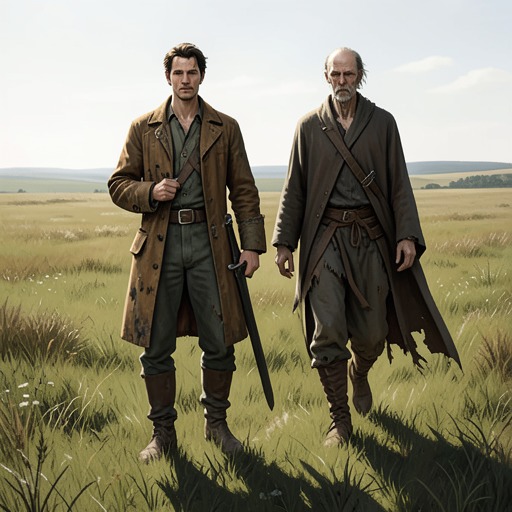
[Don Quixote](entity:character-recall-character-don-quixote-5e35e2b8dd96) persuades his neighbour [Sancho Panza](entity:character-recall-character-sancho-panza-05e2e2fa0bb3) to become his squire, promising that a conquered island may make him a governor. Sancho leaves his wife and children, bringing his ass [Dapple](entity:character-recall-character-dapple-226e7a4e501d) and provisions for the road.
The two depart secretly by night. Sancho takes the promise seriously, while Don Quixote imagines a future of kingdoms, battles, and renown.
early in the second sally
The Windmill Charge
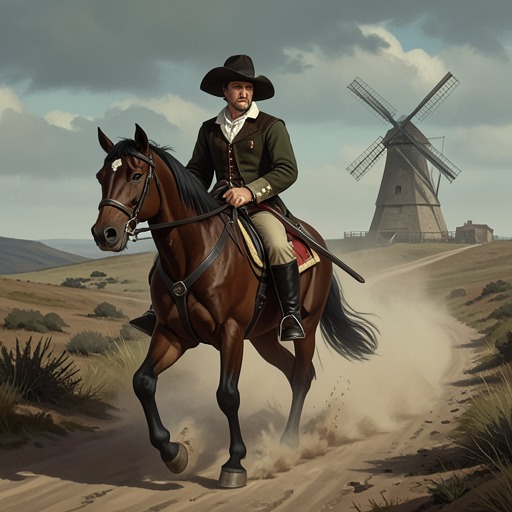
On the plains of [La Mancha](entity:location-recall-location-la-mancha-05c12a1ed921), [Don Quixote](entity:character-recall-character-don-quixote-5e35e2b8dd96) mistakes windmills for giants and charges them despite Sancho’s warning. A sail catches his lance and sends horse and rider tumbling.
He explains the defeat by claiming an enchanter transformed the giants into mills. Sancho helps him remount, and the pair continue toward further imagined adventures.
on the road to Puerto Lapice
The Monks and the Biscayan
[Don Quixote](entity:character-recall-character-don-quixote-5e35e2b8dd96) mistakes two Benedictine monks for abductors and attacks them; their muleteers beat Sancho when he tries to claim the spoils. He then confronts a Biscayan attendant who refuses to let his carriage be stopped.
The two fight with swords until the narrative abruptly breaks off, explaining that its source has run out. The interruption establishes the story’s playful conceit that Don Quixote’s history must be recovered from an Arabic manuscript.
after the Biscayan duel begins
The Manuscript Found
The narrator says he finds Arabic papers at the market in [Toledo](entity:location-recall-location-00bd30d0cd7b) and hires a Morisco to translate them. They identify [Cide Hamete Benengeli](entity:character-recall-character-cide-hamete-benenge-88cf4ece00dc) as the history’s author and continue the suspended duel.
[Don Quixote](entity:character-recall-character-don-quixote-5e35e2b8dd96) defeats the Biscayan, who is spared after promising to present himself to Dulcinea. The discovery turns the adventure into a self-conscious history assembled from supposedly recovered sources.
during the second sally
Chrysostom’s Funeral
At a goatherd’s camp, [Don Quixote](entity:character-recall-character-don-quixote-5e35e2b8dd96) hears the story of [Chrysostom](entity:character-recall-character-chrysostom-870eee0b630b), who died after loving the shepherdess [Marcela](entity:character-recall-character-marcela-745a1e5e8edc). At the burial, Marcela appears and argues that her beauty does not oblige her to return anyone’s love.
Don Quixote defends her right to leave her suitors alone and forbids them to follow her. Her speech and his intervention make the episode a striking contrast between her independence and the possessive conventions of pastoral romance.
after the funeral
The Yanguesan Beating
[Rocinante](entity:character-recall-character-e14bcc940c7b) approaches a drove of mares and is battered by their carriers. [Don Quixote](entity:character-recall-character-don-quixote-5e35e2b8dd96) and Sancho attack the men, but the carriers overwhelm them with stakes.
Injured and unable to walk properly, they struggle toward an inn. Don Quixote interprets the beating through the supposed rules of chivalry, while Sancho worries about the practical cost of their adventures.
that night
The First Inn Melee
At the inn, [Don Quixote](entity:character-recall-character-don-quixote-5e35e2b8dd96) mistakes the innkeeper’s daughter for a noble lady and [Maritornes](entity:character-recall-character-maritornes-679255cf2558) for a princess. A carrier, jealous of Maritornes, attacks him; the innkeeper and Sancho are drawn into the dark, confused brawl.
An officer of the [Holy Brotherhood](entity:organization-recall-organization-holy-brotherhood-740a99df07e6) enters looking for a supposed dead man and strikes Don Quixote with a lamp. Don Quixote explains the blows as the work of an enchanted Moor, extending his delusion rather than recognising the ordinary causes of his injuries.
the following morning
The Balsam and Blanket
[Don Quixote](entity:character-recall-character-don-quixote-5e35e2b8dd96) prepares the [Balsam of Fierabras](entity:object-recall-object-2cfe742f1a94) and believes it cures him, while Sancho drinks some and suffers severe sickness. Don Quixote then refuses to pay the innkeeper, claiming the custom of knight-errantry exempts him.
The inn’s guests toss Sancho in a blanket as Don Quixote watches helplessly from outside. The losses, pain, and unpaid bill remain real, no matter how insistently master and squire explain them as enchantments or privileges.
after leaving the inn
The Sheep Armies
[Don Quixote](entity:character-recall-character-don-quixote-5e35e2b8dd96) sees clouds of dust and imagines two armies marching toward battle, naming their leaders and describing their knights. Sancho sees sheep and repeatedly tries to correct him.
Don Quixote charges into the flocks, and shepherds knock him down with stones. He blames the sage who persecutes him for changing the armies back into sheep.
later on the road
The Funeral Procession
At night [Don Quixote](entity:character-recall-character-don-quixote-5e35e2b8dd96) mistakes a funeral party carrying a dead gentleman’s body for a band of supernatural enemies. He attacks the mourners and breaks a leg of one of the clergy.
The injured bachelor explains that the dead man is being taken to Segovia for burial. Sancho calls Don Quixote the Knight of the Rueful Countenance, a name his master accepts as a fitting new title.
the next night
The Fulling Mills
Loud, measured blows and rushing water terrify Sancho and stir [Don Quixote](entity:character-recall-character-don-quixote-5e35e2b8dd96)’s imagination. Don Quixote prepares to face a perilous adventure, while Sancho secretly ties [Rocinante](entity:character-recall-character-e14bcc940c7b)’s legs to delay him until daylight.
At dawn they discover the noise comes from fulling mills. Sancho laughs at Don Quixote’s grand speech, and Don Quixote strikes him for the mockery, exposing the fragile balance between their affection and their quarrels.
the following day
Mambrino’s Helmet
[Don Quixote](entity:character-recall-character-don-quixote-5e35e2b8dd96) sees a barber carrying a brass basin over his head against the rain and believes it is the helmet of Mambrino. He charges the man, who flees, leaving the basin behind.
Sancho recognises the object for what it is, but Don Quixote insists an enchanter has transformed it. The basin becomes a durable emblem of the gap between what he sees and what others can plainly observe.
on the road after the helmet episode
The Galley Slaves Freed
[Don Quixote](entity:character-recall-character-don-quixote-5e35e2b8dd96) questions a chain gang of galley slaves about their crimes and concludes that they are being carried against their will. He attacks their guards and breaks the chain, freeing them.
He asks the liberated men to visit Dulcinea and report what he has done. They instead stone Don Quixote and Sancho, then scatter to avoid recapture, leaving the pair exposed to the consequences of defying the law.
after the galley slaves flee
Cardenio in the Sierra
In the [Sierra Morena](entity:location-recall-location-ab63c16dbb82), Sancho discovers that [Dapple](entity:character-recall-character-dapple-226e7a4e501d) has been stolen and [Don Quixote](entity:character-recall-character-don-quixote-5e35e2b8dd96) finds a valise containing money and papers. A goatherd describes a ragged, intermittently violent young man, and [Cardenio](entity:character-recall-character-cardenio-f981421f2344) soon appears.
Cardenio recounts how he loved [Luscinda](entity:character-recall-character-fae458ae8e6d), trusted [Don Fernando](entity:character-recall-character-don-fernando-3f1dff8be331) with his secret, and was sent away while his friend pursued her. His story reveals the betrayal and sorrow that have driven him into the mountains.
recounted during the Sierra Morena stay
Cardenio’s Wedding Disaster
[Cardenio](entity:character-recall-character-cardenio-f981421f2344) explains that [Luscinda](entity:character-recall-character-fae458ae8e6d)’s father delayed their marriage, while [Don Fernando](entity:character-recall-character-don-fernando-3f1dff8be331) arranged to send Cardenio away and then sought Luscinda for himself. At her wedding, Cardenio hears her consent to marry Don Fernando and flees in despair.
He later learns that Luscinda’s written declaration named Cardenio as her true husband, but he is too overwhelmed to discover what followed. His story intertwines with [Dorothea](entity:character-recall-character-dorothea-0d5a59a96ede)’s, whose own injury also traces back to Don Fernando.
during the Sierra Morena stay
Don Quixote’s Penance
After a quarrel with [Cardenio](entity:character-recall-character-cardenio-f981421f2344), [Don Quixote](entity:character-recall-character-don-quixote-5e35e2b8dd96) resolves to imitate [Amadis of Gaul](entity:character-recall-character-17efa65a7070) and perform penance in the mountains for Dulcinea. He sends Sancho with a letter and an order for three ass-colts, and stages several mad acts for his squire to witness.
Sancho departs with the message but loses the notebook containing both documents. His mission becomes a tangle of invention and deception, as he must report back without having delivered the letter.
before she meets Don Quixote
Dorothea’s Flight
[Dorothea](entity:character-recall-character-dorothea-0d5a59a96ede) tells [the curate](entity:character-recall-character-the-curate-35c270e3b9fc) and barber that [Don Fernando](entity:character-recall-character-don-fernando-3f1dff8be331) promised to marry her, then abandoned her after possessing her. She left home disguised as a man and fled into the mountains after her servant tried to assault her.
There she hid among goatherds until the curate’s party found her. Her story connects the Sierra’s separate misfortunes and gives [Cardenio](entity:character-recall-character-cardenio-f981421f2344) hope that Don Fernando may yet be made to honour his promises.
after Sancho returns from the Sierra
The Princess Micomicona Ruse
The curate and barber enlist [Dorothea](entity:character-recall-character-dorothea-0d5a59a96ede) to pose as [Princess Micomicona](entity:character-recall-character-a2555445e925), a damsel in distress who needs [Don Quixote](entity:character-recall-character-don-quixote-5e35e2b8dd96)’s help. Sancho, believing the story, urges his master to marry her and make him a governor.
Don Quixote accepts her plea and agrees to pursue the giant who supposedly stole her kingdom. The deception provides a way to draw him away from the Sierra and back toward home.
during the return journey from the Sierra
The Lovers Reunited
At the inn, [Don Fernando](entity:character-recall-character-don-fernando-3f1dff8be331) and [Luscinda](entity:character-recall-character-fae458ae8e6d) arrive together under strained circumstances. [Cardenio](entity:character-recall-character-cardenio-f981421f2344) recognises Luscinda, and [Dorothea](entity:character-recall-character-dorothea-0d5a59a96ede) confronts Don Fernando, asking him to honour the marriage promise he made her.
Moved by her appeal and by the lovers’ reunion, Don Fernando releases Luscinda and accepts Dorothea. The intertwined crises resolve in a reconciliation that restores the couples’ hopes and gives the party a brief period of happiness.
during the same inn stay
The Ill-Advised Curiosity
The curate reads a manuscript story about [Anselmo](entity:character-recall-character-anselmo-0b8a6720ce09), who asks his friend [Lothario](entity:character-recall-character-47ebc4d0ad9b) to test his wife [Camilla](entity:character-recall-character-e9c10043d4c4)’s chastity. Lothario first resists, but Anselmo’s insistence creates the opportunity for an affair.
Camilla and Lothario deceive Anselmo with a staged scene proving her supposed virtue; later their liaison is exposed, Camilla flees, Lothario disappears, and Anselmo dies of grief. The tale offers a parallel warning about testing what is already trusted.
during the party’s stay at the inn
The Captive’s Story
A captive recounts his service in the wars, his capture at Lepanto, and years of slavery in [Algiers](entity:location-recall-location-18d6df5687fc). A young Moorish woman, [Zoraida](entity:character-recall-character-zoraida-b8725eca041d), secretly contacts him and asks for help escaping to Christian territory.
With the help of a renegade, the captive and several companions arrange a flight by boat, taking Zoraida and her father [Hadji Morato](entity:character-recall-character-dfb4e137509b). French corsairs later rob them, but the survivors reach [Spain](entity:location-recall-location-spain-336a02c89dc7), where Zoraida hopes to be baptised.
later during the inn stay
The Brothers Reunited
A judge arrives with his daughter, [Doña Clara de Viedma](entity:character-recall-character-do-a-clara-de-viedm-fe85c7f22cf7). The captive learns that the judge is his brother, who had pursued a career in letters after their father divided the family’s inheritance.
The brothers recognise each other, and the judge welcomes the captive and [Zoraida](entity:character-recall-character-zoraida-b8725eca041d), offering help with their future. [Don Luis](entity:character-recall-character-don-luis-177c37232abb), disguised as a muleteer, is also discovered following Clara, and the judge begins to consider the young couple’s marriage.
during the night after the stories
The Wine-Skin Battle
While asleep, [Don Quixote](entity:character-recall-character-don-quixote-5e35e2b8dd96) dreams that he is fighting [Princess Micomicona](entity:character-recall-character-a2555445e925)’s giant and slashes the innkeeper’s wine-skins. Sancho believes the giant’s head has been cut off, while the landlord sees only wine and ruined property.
The commotion interrupts the reading of the captive’s story and provokes the landlord’s fury. Don Quixote wakes believing the adventure has succeeded, while the others must repair the damage and placate the innkeeper.
the morning after the wine-skin battle
Don Luis Is Found
The servants of [Don Luis](entity:character-recall-character-don-luis-177c37232abb) arrive at the inn and find him disguised and travelling after Clara. He refuses to return with them, explaining to the judge that he loves Clara and wants to marry her.
The judge does not settle the matter immediately, but arranges for Don Luis to remain while the families’ wishes are considered. The episode adds another threatened separation to the crowded inn and further tests the group’s patience.
during the same morning
The Helmet and Pack-Saddle Dispute
The barber whose basin [Don Quixote](entity:character-recall-character-don-quixote-5e35e2b8dd96) took recognises his property and demands it back, while Sancho insists he owns the pack-saddle taken from [the barber](entity:character-recall-character-the-barber-c60eb6e1cfd1). Don Quixote declares the basin to be [Mambrino’s Helmet](entity:object-recall-object-mambrino-s-helmet-1532dcb04b97) and declines to settle the pack-saddle question.
A quarrel with the officers of the [Holy Brotherhood](entity:organization-recall-organization-holy-brotherhood-740a99df07e6) turns the inn into a brawl involving the travellers, servants, and innkeeper. The curate and [Don Fernando](entity:character-recall-character-don-fernando-3f1dff8be331) eventually calm the gathering and pay for the damage.
after Don Quixote recovers at home
The Third Sally Begins
After recovering from his injuries, [Don Quixote](entity:character-recall-character-don-quixote-5e35e2b8dd96) decides to leave home for a third time, and Sancho agrees to accompany him. The bachelor [Samson Carrasco](entity:character-recall-character-samson-carrasco-f4716e8e4d69) encourages the plan while privately arranging to stop Don Quixote by challenging him in disguise.
Don Quixote and Sancho set out secretly toward [El Toboso](entity:location-recall-location-el-toboso-95835ba065f2). Their departure begins the second part’s longer sequence of adventures, increasingly shaped by people who know the published history of their earlier travels.
on arrival at El Toboso
The Search for Dulcinea
[Don Quixote](entity:character-recall-character-don-quixote-5e35e2b8dd96) insists on seeking Dulcinea’s palace in [El Toboso](entity:location-recall-location-el-toboso-95835ba065f2), though neither he nor Sancho knows where it is. They wander the dark streets, mistake buildings for a palace, and fail to find her.
Sancho fears being exposed because he has never actually delivered Don Quixote’s message to Dulcinea. He persuades his master to leave the town, promising to seek her out in daylight.
the following day
Sancho’s Enchantment Deception
Sancho sees three peasant girls and claims that one of them is Dulcinea, transformed by enchantment. [Don Quixote](entity:character-recall-character-don-quixote-5e35e2b8dd96) sees only country girls and laments that a magician has hidden his lady’s beauty from him.
Sancho’s lie becomes a durable explanation for Dulcinea’s absence, and Don Quixote accepts it rather than question the fantasy. Their opposing views of the same encounter deepen the comic tension between master and squire.
soon after leaving El Toboso
The Cart of Death
A cart carrying actors dressed as Death, an angel, and other figures appears on the road. [Don Quixote](entity:character-recall-character-don-quixote-5e35e2b8dd96) mistakes the theatrical company for a threatening supernatural adventure and confronts them.
A performer dressed as a demon startles [Rocinante](entity:character-recall-character-e14bcc940c7b), throwing Don Quixote to the ground, while the actors flee from his attack. The episode turns a travelling performance into another collision between chivalric imagination and ordinary life.
during the journey toward Saragossa
The Knight of the Mirrors
[Don Quixote](entity:character-recall-character-don-quixote-5e35e2b8dd96) meets a knight who claims to have defeated him before and demands that he admit his lady is the most beautiful. The two agree that the loser will obey the victor’s terms, including a year’s retirement for Don Quixote if he is defeated.
The opponent is [Samson Carrasco](entity:character-recall-character-samson-carrasco-f4716e8e4d69) in disguise, accompanied by [Tom Cecial](entity:character-recall-character-tom-cecial-d571232c7103). Their challenge is a planned effort to bring Don Quixote home, though Don Quixote believes it to be an authentic chivalric contest.
the next morning
The Knight of the Mirrors Defeated
[Don Quixote](entity:character-recall-character-don-quixote-5e35e2b8dd96) charges the [Knight of the Mirrors](entity:character-recall-character-c84196e8ed64), whose horse fails to advance, and knocks him from the saddle. When he removes the fallen knight’s helmet, he sees the face of [Samson Carrasco](entity:character-recall-character-samson-carrasco-f4716e8e4d69) but decides an enchanter must have transformed it.
Carrasco yields and promises to visit Dulcinea, while Don Quixote insists the vanquished man was not truly his friend. Carrasco’s plan fails, and Don Quixote continues his journey in renewed confidence.
after the duel
The Lions Released
A cart carrying two lions crosses the road. [Don Quixote](entity:character-recall-character-don-quixote-5e35e2b8dd96) interprets it as a challenge and insists that the cage be opened, despite the keeper’s warnings and the duke’s later guest [Don Diego de Miranda](entity:character-recall-character-don-diego-de-mirand-b49bfafd409d)’s attempts to dissuade him.
The male lion yawns, turns away, and lies down again. Don Quixote declares victory and takes the title Knight of the Lions, while the keeper and Sancho acknowledge that no combat actually occurred.
during the journey after the lion episode
The Cave of Montesinos
[Don Quixote](entity:character-recall-character-don-quixote-5e35e2b8dd96) descends by rope into the [Cave of Montesinos](entity:location-recall-location-cave-of-montesinos-952af70e74f9) while Sancho and the guide wait above. When he is hauled out, he claims to have spent days below and describes a crystal palace, [Montesinos](entity:character-recall-character-montesinos-3900f1ba86ba), [Durandarte](entity:character-recall-character-durandarte-9f8173e9261e), [Belerma](entity:character-recall-character-belerma-6d7b83581102), and enchanted companions.
He also says he saw Dulcinea transformed into a peasant girl and was asked for money by her attendant. Sancho doubts the account, while Don Quixote insists he witnessed it directly, leaving its truth unresolved.
after the cave adventure
The Puppet-Show Destruction
At an inn, [Master Pedro](entity:character-recall-character-master-pedro-1d39d6b2820c) presents a puppet show about [Don Gaiferos](entity:character-recall-character-don-gaiferos-ca99c58211a2) rescuing [Melisendra](entity:character-recall-character-melisendra-4f22d3132a22) from [Saragossa](entity:location-recall-location-saragossa-ae14a493c450). [Don Quixote](entity:character-recall-character-don-quixote-5e35e2b8dd96) becomes absorbed in the action and mistakes the puppets for real people pursued by Moors.
He attacks the stage with his sword, smashing the puppets and equipment. Once the illusion breaks, he agrees to pay Master Pedro for the damage, while continuing to blame enchanters for what he saw.
during the road to Saragossa
The Braying-Town Dispute
[Don Quixote](entity:character-recall-character-don-quixote-5e35e2b8dd96) and Sancho encounter men from two villages whose feud began after two officials brayed while searching for a lost ass. The mockery spread, and the insult has brought armed villagers into the field.
Don Quixote argues that a town cannot be insulted by one person and counsels against fighting over a trivial taunt. Sancho’s own braying, however, provokes one of the men to strike him, and Don Quixote flees under a shower of stones.
after the encounter with the braying towns
The Duke and Duchess Welcome Them
A hunting party led by the Duke and the Duchess recognizes [Don Quixote](entity:character-recall-character-don-quixote-5e35e2b8dd96) from his published adventures and invites him to their castle. They decide to indulge his delusions with elaborate staged entertainments.
The duke and duchess enjoy the contrast between Don Quixote’s solemnity and the ordinary explanations for what happens. Sancho, meanwhile, hopes the duke will fulfil the promise of an island governorship.
during the early days at the castle
The Hunt and the Countess
[The Duke](entity:character-recall-character-the-duke-9b23ddf5b425) and Duchess take [Don Quixote](entity:character-recall-character-don-quixote-5e35e2b8dd96) and Sancho on a hunt and arrange an elaborate spectacle involving an enchanted carriage and a distressed countess. Their performance revives the chivalric world Don Quixote expects to inhabit.
The countess, presented as the [Countess Trifaldi](entity:character-recall-character-4b59de6cf677), asks for Don Quixote’s help against the enchanter [Malambruno](entity:character-recall-character-704a27c348c3). The duke’s household plans the episode to keep their guest entertained and to test how fully he will believe it.
during the Countess Trifaldi’s visit
The Countess’s Tale
The [Countess Trifaldi](entity:character-recall-character-4b59de6cf677) tells how [Malambruno](entity:character-recall-character-704a27c348c3) punished [Princess Antonomasia and Don Clavijo](entity:relation-recall-relation-2bd0cd417e4c) by transforming them, and caused the duennas to grow beards. She asks [Don Quixote](entity:character-recall-character-don-quixote-5e35e2b8dd96) to confront the enchanter and restore them.
Don Quixote accepts, while Sancho protests at the demand that he whip himself to disenchant Dulcinea. The story binds the staged adventure to the ongoing condition of Sancho’s promised lashes.
that night
Clavileño’s Flight
[Don Quixote](entity:character-recall-character-don-quixote-5e35e2b8dd96) and Sancho mount the wooden horse Clavileño blindfolded, believing it will carry them to [Malambruno](entity:character-recall-character-704a27c348c3). Servants use bellows and heat to simulate flight, while the duke’s household stages the illusion below.
A timed explosion throws the riders to the ground. A message declares the duennas disenchanted, though Sancho has not yet completed his lashes; Don Quixote accepts the spectacle as a successful adventure.
after the Clavileño episode
Altisidora’s Courtship
[Altisidora](entity:character-recall-character-altisidora-df555d3c74c3) sings to [Don Quixote](entity:character-recall-character-don-quixote-5e35e2b8dd96) and pretends to be overwhelmed by love for him. He rejects her, affirming his fidelity to Dulcinea, while the duke and duchess encourage the joke.
Later, attendants let cats and bells into his chamber. Don Quixote fights the animals in the dark and is left with a scratched face, convinced that enchanters are tormenting him.
during Don Quixote’s stay at the castle
Doña Rodríguez Seeks Justice
[Doña Rodríguez](entity:character-recall-character-do-a-rodr-guez-293f00716cfa) visits [Don Quixote](entity:character-recall-character-don-quixote-5e35e2b8dd96) at night and asks him to defend her daughter, whom a wealthy farmer’s son has seduced and abandoned. Don Quixote promises to challenge the man and secure justice.
The duke agrees to stage a combat, but his household secretly plans to substitute a lacquey for the alleged offender. The episode turns Doña Rodríguez’s genuine grievance into another of the castle’s theatrical traps.
after Don Quixote’s departure from the castle
Sancho Governs Barataria
[The Duke](entity:character-recall-character-the-duke-9b23ddf5b425) sends Sancho to govern [Barataria](entity:location-recall-location-c8c8a1a0cefc), a town presented to him as an island. Sancho receives the office with confidence but soon discovers that governing brings little comfort, especially when [Doctor Pedro Recio](entity:character-recall-character-doctor-pedro-recio-0a026981e6c3) restricts his meals.
Sancho issues ordinances and hears cases with surprising fairness and practical judgment. His decisions include a dispute over money hidden in a cane, a woman’s accusation of assault, and a puzzle about an oath and a gallows.
during the first days of his governorship
Sancho’s Justice
Sancho recognizes that a cane contains the ten gold crowns a borrower denies receiving, and orders the hidden money given to the lender. In a separate case, he hears a woman accuse a man of assault and rules that she must return the purse he had given her after she proves unable to defend it when he demands it back.
He also resolves a bridge-and-gallows dilemma by advising that the man be allowed to pass, reasoning that the law’s two contradictory outcomes make mercy the wiser course. His judgments win admiration, even from those who arranged the governorship as a joke.
after several days of Sancho’s rule
The False Siege
The duke’s household stages a night attack on [Barataria](entity:location-recall-location-c8c8a1a0cefc), arming Sancho and alarming him with cries that the enemy has entered the town. Pinned between shields and unable to move freely, he is knocked about as the mock battle unfolds.
Once the alarm ends, Sancho refuses to continue as governor. He tells the duke’s servants that office has brought hunger and danger rather than the life he wanted, and he chooses to return to ordinary work.
after resigning the governorship
Sancho Falls into a Pit
On the road to rejoin [Don Quixote](entity:character-recall-character-don-quixote-5e35e2b8dd96), Sancho and [Dapple](entity:character-recall-character-dapple-226e7a4e501d) fall into an old pit. Sancho cannot climb out and laments the loss of his governorship, but discovers a passage leading into a cavern.
Don Quixote hears his cries and returns with help. Sancho is hauled out, reuniting with his master after abandoning the office and recovering his desire for the simpler life of a squire.
after Sancho’s return
The Pastoral Plan
[Don Quixote](entity:character-recall-character-don-quixote-5e35e2b8dd96) and Sancho leave the duke’s estate and discuss their future. Don Quixote proposes that they become shepherds during his year of enforced retirement, imagining a pastoral life filled with poetry and idealized companionship.
Sancho is willing to consider the plan, though he remains concerned about practical matters and his family. Their return journey continues under the terms imposed by the Knight of the White Moon.
on the journey homeward
The Bull Stampede
[Don Quixote](entity:character-recall-character-don-quixote-5e35e2b8dd96) and Sancho encounter a company rehearsing a pastoral pageant, but soon a herd of bulls and oxen charges along the road. Don Quixote stands his ground and is trampled along with Sancho and their animals.
The incident leaves them bruised and humbled, another reminder that the countryside does not yield to the rules of chivalric fantasy. They continue toward their village despite the injuries.
after the bull stampede
Don Quixote Rejects Saragossa
Sancho reads aloud from a copy of the apocryphal sequel by [Avellaneda](entity:character-recall-character-avellaneda-2d3b0215a452), prompting [Don Quixote](entity:character-recall-character-don-quixote-5e35e2b8dd96) to realize that another author has published a continuation of his adventures. He resolves not to travel to [Saragossa](entity:location-recall-location-saragossa-ae14a493c450), where the false Don Quixote was said to have gone.
Instead, Don Quixote chooses a different route toward [Barcelona](entity:location-recall-location-barcelona-c4abb0c424bd), determined to distinguish himself from the impostor. The rival book now becomes an explicit presence in the novel’s plot.
on the road toward Barcelona
Claudia and Vicente
[Don Quixote](entity:character-recall-character-don-quixote-5e35e2b8dd96) and Sancho meet [Roque Guinart](entity:character-recall-character-roque-guinart-89f3f5e82118), a bandit leader whose company shelters them. [Claudia Jerónima](entity:character-recall-character-claudia-jer-nima-e9e33fb9ab43) arrives and explains that, believing [Don Vicente Torrellas](entity:character-recall-character-don-vicente-torrell-b05ba13268f7) had promised to marry her but was taking another wife, she shot him.
They find Vicente dying, and he denies that he intended to marry anyone else. Claudia grieves over his death and resolves to enter a convent, while Roque offers to protect her father from retaliation.
after reaching Barcelona
The Enchanted Head
At [Don Antonio Moreno](entity:character-recall-character-don-antonio-moreno-081574ae7166)’s house in [Barcelona](entity:location-recall-location-barcelona-c4abb0c424bd), [Don Quixote](entity:character-recall-character-don-quixote-5e35e2b8dd96) encounters a bronze head that appears to answer questions. Sancho and the guests test it, asking about personal matters and receiving replies that seem uncannily informed.
The head is later revealed to be a mechanical device operated by Don Antonio’s nephew from a room below. The household’s elaborate deception reflects the growing public awareness of Don Quixote’s fame and reputation.
during the Barcelona visit
The Printing House
[Don Quixote](entity:character-recall-character-don-quixote-5e35e2b8dd96) visits a printing house and meets a man preparing a translation, then finds the apocryphal continuation attributed to [Avellaneda](entity:character-recall-character-avellaneda-2d3b0215a452). He condemns its falsehood and resents its misrepresentation of his life.
The visit makes the novel’s concern with authorship and printed fame part of the action. Don Quixote sees his own story circulating beyond his control, while the counterfeit sequel becomes a challenge he must answer through his deeds.
during the Barcelona visit
Ana Félix’s Rescue
A galley captures a small vessel carrying [Ana Félix](entity:character-recall-character-ana-f-lix-7f7e9cfb69dc), a Morisco woman, and [Don Gaspar Gregorio](entity:character-recall-character-don-gaspar-gregorio-ff773d818335), her beloved. Ana reveals her identity and her family’s exile from [Spain](entity:location-recall-location-spain-336a02c89dc7), while [Ricote](entity:character-recall-character-ricote-30fdc875005c) recognizes her as his daughter.
[Don Gregorio](entity:character-recall-character-don-gregorio-6f44a380a0aa) is rescued from [Algiers](entity:location-recall-location-18d6df5687fc), and Ricote and Ana are reunited. Their story gives personal weight to the expulsion of the Moriscos and exposes the divided loyalties created by forced exile.
later in Barcelona
The Knight of the White Moon
A knight calling himself the Knight of the White Moon challenges [Don Quixote](entity:character-recall-character-don-quixote-5e35e2b8dd96) to admit that his lady surpasses Dulcinea. He makes the terms that the loser must retire to his village for a year and refrain from knight-errantry.
The challenger is [Samson Carrasco](entity:character-recall-character-samson-carrasco-f4716e8e4d69) in disguise, though Don Quixote does not recognize him. The agreed contest puts Don Quixote’s identity and vocation at stake.
the day of the duel
Don Quixote Defeated
The Knight of the White Moon charges and knocks [Don Quixote](entity:character-recall-character-don-quixote-5e35e2b8dd96) from [Rocinante](entity:character-recall-character-e14bcc940c7b). Under the agreed terms, Don Quixote must return home and give up knight-errantry for a year.
Though he admits defeat, he refuses to concede that any woman is more beautiful than Dulcinea. The loss forces him toward retirement and begins the final movement of the novel toward home and death.
on the journey back from Barcelona
Sancho’s Self-Flagellation
[Don Quixote](entity:character-recall-character-don-quixote-5e35e2b8dd96) urges Sancho to complete the lashes supposedly required to disenchant Dulcinea. Sancho agrees to a paid arrangement but secretly strikes trees rather than his own body, while Don Quixote counts the sounds.
The deception allows Sancho to preserve his skin while satisfying his master’s hopes. Don Quixote believes the number is being completed, and Sancho continues to bargain over the cost and pace of the task.
near the end of the return journey
Don Álvaro Tarfe’s Testimony
At an inn, [Don Quixote](entity:character-recall-character-don-quixote-5e35e2b8dd96) meets [Don Álvaro Tarfe](entity:character-recall-character-don-lvaro-tarfe-a2e7155d384f), a character from [Avellaneda](entity:character-recall-character-avellaneda-2d3b0215a452)’s sequel. Don Quixote asks him to swear that the Don Quixote and Sancho of that book are not the same men before him.
Tarfe gives the requested declaration before a local official. The scene directly confronts the false sequel and formally separates its characters from Cervantes’s own pair.
after the meeting with Don Álvaro Tarfe
The Shepherds’ Eclogue
On the final approach to home, [Don Quixote](entity:character-recall-character-don-quixote-5e35e2b8dd96) again imagines a pastoral life, proposing that he and Sancho become shepherds and invite their friends to join them. Sancho plays along, though he remains attentive to food and the practical conditions of the plan.
The pastoral scheme offers a gentler substitute for knight-errantry during the year of retirement, but it remains a fantasy that will never be carried out. Don Quixote and Sancho reach their village and are welcomed by their families.
near the end of the novel
Don Quixote Comes Home
The curate, barber, niece, and housekeeper receive [Don Quixote](entity:character-recall-character-don-quixote-5e35e2b8dd96) at home and hope that quiet care will restore him. Sancho returns to [Teresa](entity:character-recall-character-c3a3790495c9) and Sanchica, talking of the governorship and the riches he expects someday to share.
The household watches Don Quixote closely, but his mind continues to turn toward future adventures. He is soon taken ill, and the people around him fear that another escape from home may follow.
after several days of fever
Don Quixote Regains His Senses
After six days in bed, [Don Quixote](entity:character-recall-character-don-quixote-5e35e2b8dd96) wakes with his reason restored and rejects the books of chivalry that had shaped his delusions. He identifies himself as Alonso Quixano the Good and asks for a confessor and a notary.
Sancho pleads with him to recover and resume the planned pastoral life, but Don Quixote understands that death is near. His recovery brings clarity, but no time to begin a new life.
the novel’s final days
The Death of Don Quixote
[Don Quixote](entity:character-recall-character-don-quixote-5e35e2b8dd96) makes his will, leaving his property to his niece [Antonia Quixana](entity:character-recall-character-antonia-quixana-7fbc81cd1b90) and directing that she not marry a man who reads books of chivalry. He also asks his executors to forgive the author of the apocryphal sequel.
After receiving the sacraments and repudiating his former fantasies, he dies peacefully in bed. Sancho, the household, and his friends mourn him, while the narrator insists that no further continuation should revive him.